
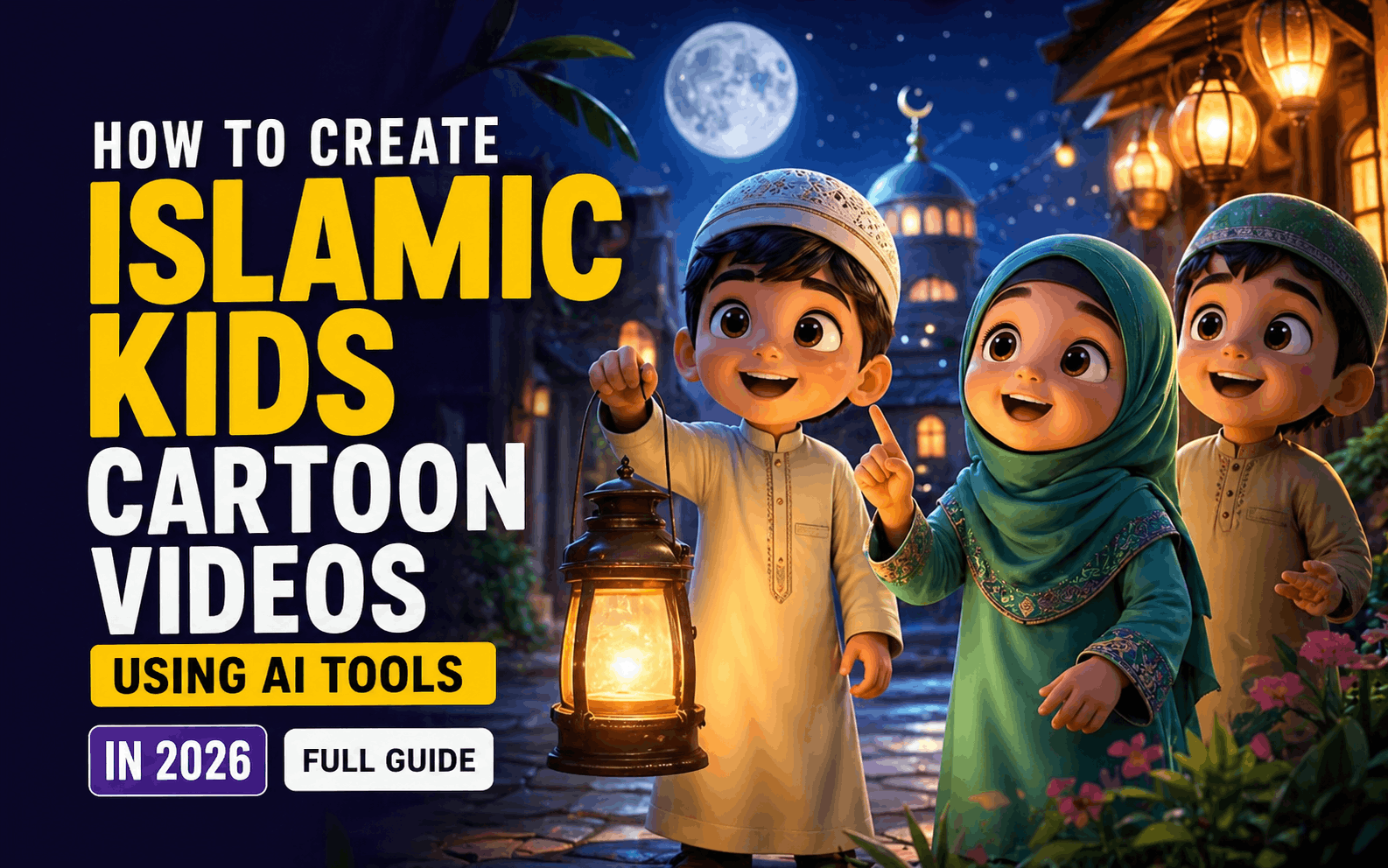
If you have been scrolling through YouTube lately, you have probably noticed something — Islamic kids cartoon channels are absolutely exploding. Videos with titles like “Shaitaan Ka War” or “Bismillah Or Shaitaan” are pulling in hundreds of thousands, even millions of views. Channels producing this type of content are growing fast, and the most interesting part? Many of them are now using AI tools to create entire episodes from scratch.
In this guide, you will learn exactly how to create your own Islamic kids cartoon videos using AI ” from writing the story script to generating image prompts and video animations — even if you have zero experience in animation or filmmaking.
Why Islamic Kids Cartoon Content Is Booming Right Now
The demand for Islamic kids content on YouTube has never been higher. Parents across Pakistan, India, the Middle East, and Muslim communities worldwide are actively searching for cartoon videos that are both entertaining and morally grounded for their children.
What makes this niche so powerful right now is a combination of three things: a massive underserved audience, a story format that works incredibly well on YouTube (suspense + Islamic solution + moral ending), and the arrival of AI tools that make production possible for individual creators without a studio budget.
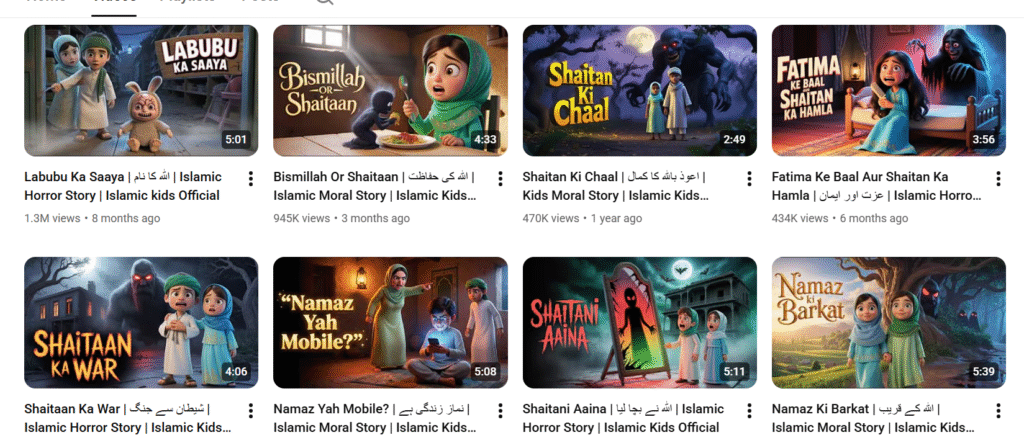
Channels that publish consistently in this niche are seeing rapid subscriber growth. Videos in the 3 to 6 minute range are performing especially well, often reaching 300K to 1.3 million views within months of uploading.
What Type of Content Works Best
Before jumping into the tools, it helps to understand the format that is consistently generating the most views in this niche.
The highest-performing Islamic kids cartoons follow a specific emotional arc. The video begins with a hook — something slightly mysterious or scary that immediately grabs the child’s attention. Then comes a build-up showing normal daily life, followed by a conflict where the influence of Shaitan or a morally wrong choice begins to affect the main character. The story reaches a peak suspense moment, which is always kid-safe — a shadow, a strange feeling, or a frightening situation. Then comes the turning point: the child uses Bismillah, Auzubillah, or calls on Allah, and immediately the situation resolves. The video always ends with a clear, simple moral lesson.
This structure works because it combines the natural curiosity and excitement children feel toward suspense stories with the comfort and empowerment of Islamic values. Children come away feeling both entertained and spiritually confident.
The AI Tools You Need
Creating a full Islamic kids cartoon episode with AI in 2026 requires a small stack of tools, most of which have free plans available.
For Script and Prompt Generation:
ChatGPT (GPT-4o) or Claude by Anthropic are the best options for generating story scripts, character descriptions, image prompts, and video prompts. Both are capable of producing detailed, structured content when given a good system prompt.
For Image Generation:
Leonardo AI, Adobe Firefly, and Ideogram are currently the strongest free or low-cost options for generating consistent cartoon-style character images. For the 3D Pixar-style look that performs well in this niche, Leonardo AI’s anime and illustration models produce solid results.
For Video Generation:
Google Veo 3, Kling AI, and Pika Labs are the leading AI video generators in 2026. Kling AI and Pika Labs both offer free credits to new users. These tools can take a detailed image prompt and turn it into a 5 to 8 second animated clip with realistic motion — exactly the length needed for each scene in this format.
For Voice and Audio:
ElevenLabs and PlayHT both offer free tiers for generating natural-sounding Urdu or Roman Urdu voiceovers. For background music and sound effects, Pixabay and Freesound have large free libraries of Islamic-appropriate audio.
For Final Editing:
CapCut remains the most popular free video editor among content creators in 2026. It handles everything from assembling clips to adding subtitles, transitions, and background music.
How the AI Episode Generation Process Works
The most efficient workflow for creating these videos uses a structured AI prompt — often called a master prompt or system prompt — that guides the AI through the entire episode creation process step by step.
Here is how the process works from start to finish:
Step 1 — Title Generation
You start by asking the AI to generate 10 video title ideas in the exact style that performs well on YouTube. Good titles in this niche combine a slightly suspenseful element with a clear Islamic reference, written in Roman Urdu with Arabic text included. Titles like these create immediate curiosity and strong click-through rates.
Step 2 — Story Script
Once you select a title, you tell the AI how long your video should be — typically 5 to 8 minutes. The AI then calculates the exact number of 6-second clips needed and writes a complete story script in Roman Urdu, with every clip clearly numbered and every dialog written out.
Step 3 — Character Design
The AI creates detailed visual descriptions for every character in the story — skin tone, clothing, facial features, height, and personality. These descriptions are stored and reused consistently across every image prompt so your characters look the same throughout the entire episode.
Step 4 — Image Prompts
The AI generates fully detailed, self-contained image prompts for every single scene. Each prompt is written in English and includes the visual style, character appearance, environment details, camera angle, and emotional expression. These prompts are ready to paste directly into Leonardo AI or Adobe Firefly.
Step 5 — Video Motion Prompts
For each image, the AI also generates a matching video motion prompt optimized for tools like Google Veo 3 or Kling AI. These prompts describe exactly how the characters should move, how the camera should behave, and what the lighting should look like — all within a 6-second clip.
Step 6 — Assembly
Once you have all your generated images and video clips, you bring everything together in CapCut. Add the voiceover, background music, transitions, and Islamic-themed intro and outro. Export and upload.
Tips for Getting the Best Results
Consistency is the biggest challenge when working with AI-generated images. Characters can look slightly different from one image to the next if you are not careful with your prompts. The solution is to always include the full character description in every single image prompt — never reference “the same character as before.” Each prompt should work completely on its own.
For the video motion prompts, always specify the camera movement explicitly. Slow cinematic zooms work well for emotional moments. A slight handheld shake adds tension during suspense scenes. Wide establishing shots work best when introducing a new location.
When generating Urdu dialogs, keep each line short — no more than 8 to 10 words. Remember that each clip is only 6 seconds long. Long dialogs will either feel rushed or will need to be split across multiple clips.
For thumbnails, look carefully at what is working on the top-performing channels. The style that gets the most clicks combines a scared or surprised child character, a dark atmospheric background with glowing or shadowy Islamic elements, bold colorful text in both Roman Urdu and Arabic script, and a strong contrast between the character and background.
How Much Does It Cost to Start
You can realistically start this type of channel with zero upfront cost using free tiers across all the tools mentioned above. The main investment is time — a single 5-minute episode takes approximately 6 to 10 hours to produce using this AI workflow when you are first learning.
As you build your template library and become faster with the tools, production time drops significantly. Many creators in this niche are producing one full episode per week using AI, which is a realistic pace for growing a channel consistently.
Once your channel begins monetizing through YouTube AdSense, the typical RPM for Islamic kids content targeting Pakistani and South Asian audiences ranges from moderate to high, especially for videos that attract diaspora audiences in the UK, USA, Canada, and Australia where advertising rates are significantly higher.
Final Thoughts
Islamic kids cartoon content is one of the most genuinely rewarding niches on YouTube right now — both in terms of audience demand and the meaningful impact it has on young viewers. AI tools have made it possible for individual creators to produce content that would have required an entire animation studio just a few years ago.
The key to success in this niche is not just the tools — it is understanding the story format that works, being consistent with your content schedule, and genuinely caring about the quality and message of what you are creating for children.
Start with one video. Use the AI workflow. Publish it. See how your audience responds. Every great channel began with a single upload.